
MultiTech Rheology Modifier B
1 of 80 products in this brandChemical Name: Silica gel, pptd., cryst.-free
Functions: Processing Aid, Rheology Modifier, Rheology Modifier, Thickener
Chemical Family: Silica
Labeling Claims: Low VOC
Compatible Polymers & Resins: Epoxies (EP)
Enhanced TDS
Identification
- Chemical Family
- Chemical Name
Applications
- Compatible Polymers & Resins
Applications & Uses
- Applications
-
- Very well suited for Hydrophobic silica application.
- Well suited for Anti-settling application.
Typical Applications
- Plasticizers
- Blowing agents
- Antistatic agents
- Anti-fogging agents
Benefits & Claims
- Labeling Claims
End Uses
- Plastics & Elastomers End Uses
Features
- CASE Ingredients Features
- Materials Features
Functions
- CASE Ingredients Functions
- Plastics & Elastomers Functions
- Function
-
Thickener, Rheology Modifier, Processing Aid
Packaging & Availability
- Country Availability
- Regional Availability
Processing Methods
- Plastics & Elastomers Processing Methods
Regulatory & Compliance
- Chemical Inventories
Technical Details & Test Data
- AEROSIL® Fumed Silica
-
- AEROSIL® fumed silica is a highly dispersed, amorphous, very pure silica manufactured by high-temperature hydrolysis of silicon tetrachloride in an oxyhydrogen gas flame. The primary particles formed in the AEROSIL® process are virtually spherical and free of pores.
- During the formation of the primary particles, aggregates are formed which further accumu- late into agglomerates. Under shear, these agglomerates can be returned back into smaller aggregates.
- Siloxane and silanol groups are found on the surface of the AEROSIL® particles. This latter type of functional group in particular is responsible for the hydrophilic behavior of untreated AEROSIL®. Figure shows the surface groups of hydrophilic AEROSIL® grades.
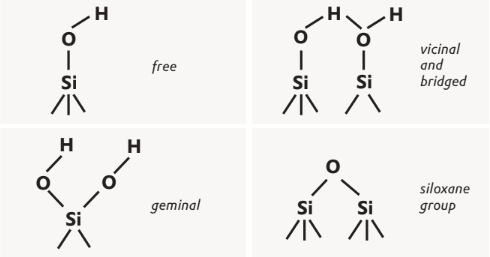
Surface groups of hydrophilic AEROSIL® grades.
Figure below provides a summary of these and highlights the difference between them and hydrophilic AEROSIL® grades according to the schematically represented surface groups. All hydrophobic AEROSIL® grades bear the suffix “R” to indicate their water- repellent character.
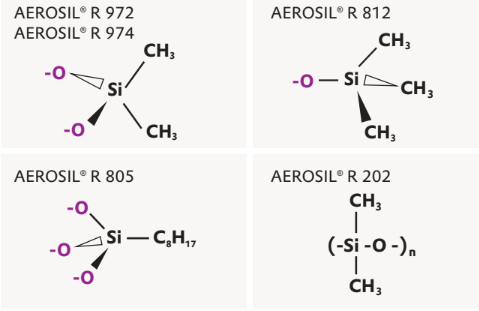
Surface groups of hydrophobic AEROSIL® grades.
The hydrophobic nature of aftertreated AEROSIL® grades compared with AEROSIL® 300 can be illustrated by means of moisture adsorption in increasingly humid conditions. Figure below shows the corresponding isotherms.
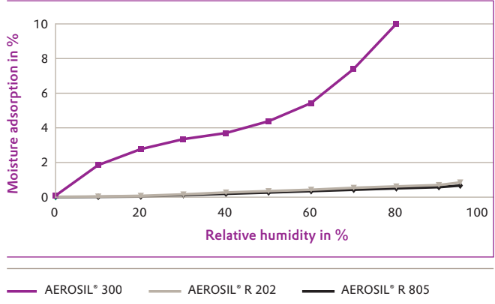
Adsorption isotherms of various AEROSIL® grades at room temperature (small samples).